
Access
To access the Configuration Area, select System Administration from the user menu and then Configuration Area (in the Files section).
Contents
Functionality
A File Browser or file manager provides a user interface to work with file systems. Some of the most common operations performed on files or groups of files are: create, edit, rename, move, copy, delete, search/find etc. Files are typically displayed in a hierarchy. Some file browsers may even contain features such as forward and back navigational buttons.
Overview
Configuration Area is the physical part of an application that provides User Interface to the files (in particular, Groovy-script files) that provide the project configuration.
There are two sections in the Configuration Area Browser:
- Standard application source files
- Project source files
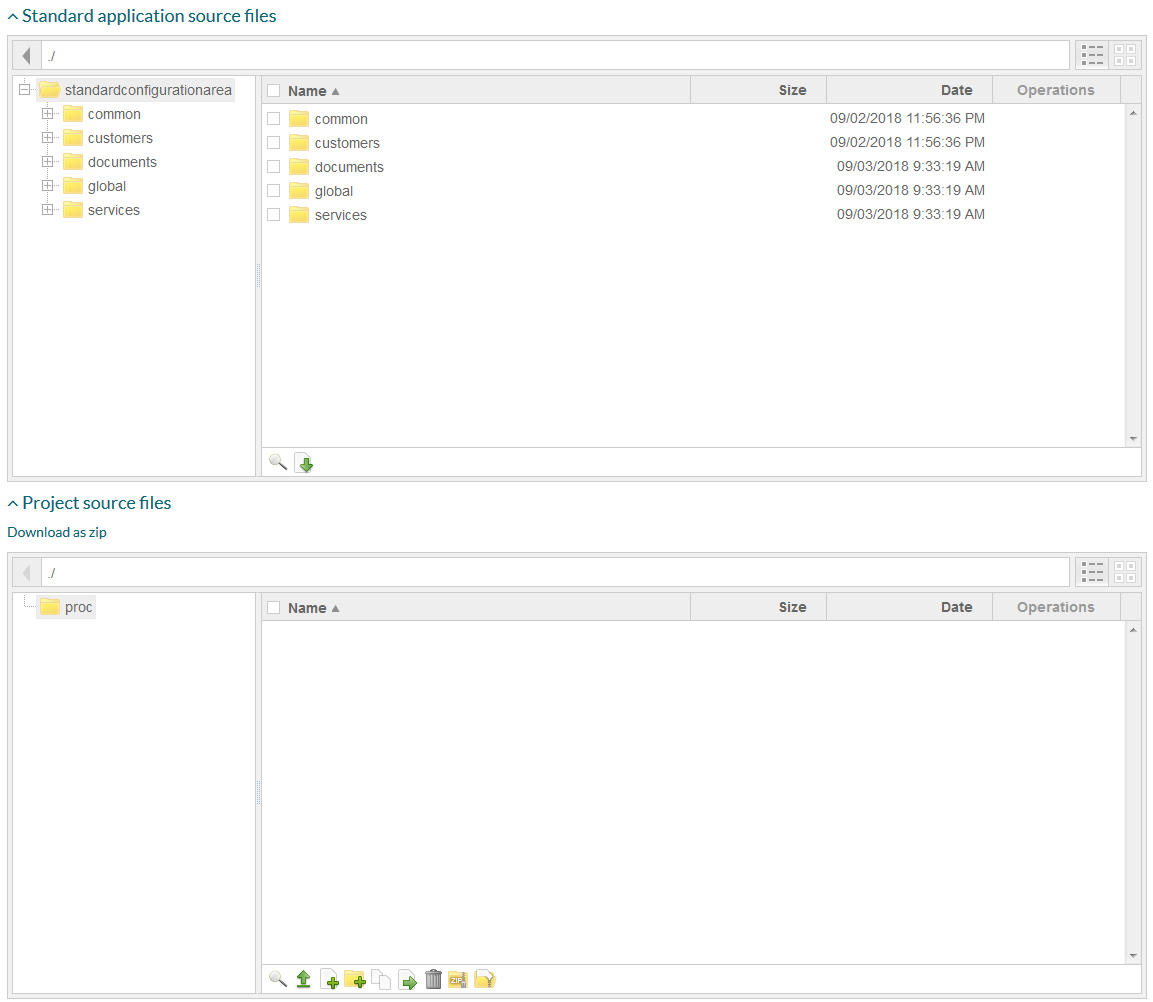
Standard application source files section is delivered with the application as standard system configuration and is read-only.
Project source files section is a space where you can customize standard files.
To download all the files in the Configuration Area, click the link Download as zip. It downloads a zip file by name configurationArea.zip.
The sections provide information on the various directories, sub-directories and files within them, details such as Name, Size of each file, Date the file or folder was created on and various Operations that can be performed to the file / folder represented by different icons/symbols.
Files/folders can be selected by clicking the appropriate
 box as required.
After selection, click on any of the following icons/symbols required:
 - to search for files/folders.
 - to upload selected files/folders.
 - to create files.
 -
to create folders.
-
to create folders. -
to
copy selected zipped files/folders.
-
to
copy selected zipped files/folders. -
to move
selected zipped files/folders.
-
to move
selected zipped files/folders. -
to
delete selected zipped files/folders.
-
to
delete selected zipped files/folders. -
to
zip selected zipped files/folders.
-
to
zip selected zipped files/folders. -
to unzip selected zipped files/folders.
-
to unzip selected zipped files/folders. -
to edit selected files.
-
to edit selected files.
To customize the files from the standard sources section you can either:
- Select the files that need to be customized by selecting the appropriate check boxes on the right hand from the filenames in the
Standard application source files section and click
 , this will copy the selected files to the corresponding directory in the
Project source files section. Now you can customize them using
or download, change and re-upload the files.
, this will copy the selected files to the corresponding directory in the
Project source files section. Now you can customize them using
or download, change and re-upload the files. - Manually create the same path to the desired file as in
Standard application source files section (by creating the appropriate folders using
) in the
Project source files section and put the customized files there.
Search
Use the
icon to search for files and directories in the Area. This opens a pop-up window where if the user knows the name and location of the file/folder, can type in the details and click
Search to initiate search. Search will be performed in current directory and all sub-directories recursively. If file details are not provided, clicking
Search will pull up the entire directory listing and selection can be made by clicking on the appropriate folder. Use the
Cancel button to cancel the search operation.
Upload File(s)
The process of transferring a file from your file system to the Area via the fiile browser is referred to as Upload. This option allows users to directly add files to the Area. While only one file can be uploaded at a time, there is no restriction on the file type.
To upload a file, click the
icon at the bottom of the browser to open an upload dialog box. Enter a name of the file to be uploaded or use
Browse... to select it and then enter the file path and click the
Upload button to upload.
- Files that are .ZIP files are not unpacked while uploading. A ZIP file can contain one or more files.
- It is not allowed to upload an entire folder at once, only files can be uploaded.
- The file is uploaded to the root directory (default location) if the To Location is not specified during the upload
Create File
The process of creating an empty file is defined as Create File. Any file type, such as text file(.txt), doc file(.doc), excel files(.xls), etc. can be created.
Click the
icon displayed at the bottom of the browser. A dialog box opens. By default, the current folder is the location of a new file. Alternatively, enter the location details for the file manually. Enter the file name with the desired extension and then click
Create to create a file.
Create Folder
Click the
icon, which opens a dialog box. By default, the path is the current folder in the Area. Alternatively, enter the location details for the folder manually. Enter a folder name and then click
Create to create a new folder.
Note that the folder's path must refer to a valid path of the folder starting at the root level of a volume or at the level of the database folder.
Copy File(s)
This function adds copies of data or files (text or pictures) to the location specified while leaving the original data or the file unchanged.
Select the file or folder to be copied, click one of the
icons, either in the
Operations column of the browser or the one at the bottom of the browser. Provide the new file/folder name with the path name/location and click
Copy to initiate copying.
Move File(s)
This function moves files or folders from an existing location to another.
Select the file or folder to be moved, click the
icon displayed in the
Operations column of the browser or at the bottom of the browser. Specify the new path name/location to which the file/folder is to be moved and click
Move.
While moving the file or folder, if the destination folder is not found, the folder is created.
Delete File(s)
Delete removes data or files from the existing server list.
Select the file or folder to be moved, click the
icon in the
Operations column of the table or at the bottom of the browser. A confirmation dialog appears, click
Ok to confirm deletion.
You can configure the automatic removal of unnecessary data in the Work Area in cleanupConfiguration.json located in the Configuration Area under the following path: ./integration/workarea.
Deleted files or folders cannot be retrieved.
Create Zip Archive
Files/folders can be compressed using ZIP. Select the file/folder to be compressed and click the
icon. Provide the zip file name and the location where the file/folder should be saved. Click
Zip to zip.
Unzip Archive
Use the unzip function to decompress zipped files/folders. Select the zipped file/folder to be unzipped, click the
icon at the bottom of the browser which opens a dialog window. If the file/folder to be unzipped has not been selected, type the name of the Zip file. Click
Unzip to unzip the file/folder.
If a file within a zipped file/folder already exists in the destination location or some other selected zip file, either change the destination or remove the existing files manually from the destination or deselect the zip file which contains the duplicate files and try to unzip again.
Edit Files
Use the
icon under the
Operations column of the file browser table to edit files. However, please note that the e
ditor does not work properly with binary files like xls, pdf, jpg and etc. Use the appropriate editor to modify such files.